
School of Fine Arts
The new Peruvian painting
By Edgardo Pérez Luna
The current Peruvian painting now has a brilliant generation of new artists emerged from the National School of Fine Arts. In the cozy halls of the Institute of Contemporary Art, the expression of the new plastic tendencies is exhibited. We are pleased to separate them for their singular qualities, and because they are the happy fruit of a resolute vocation forged in terms of honesty and sincere artistic search.
Dante Gavidia, Alfredo Basurco, Nelly Bulnes, Gerardo Chávez, Enrique Galdos, José Milner, Edmundo Panta, Alberto Quintanilla, Oswaldo Sagástegui and Tilsa Tsuchiya are the new painters who insinuate, animated by a renovating vitality, the promise of a possible national artistic style. They are the result, in our opinion, of the pedagogical orientation imparted in this first center of plastic instruction. Through them, for the first time in the National School of Fine Arts we perceive that the supreme art of knowing how to look and feel, which is indispensable in the learning of art, has begun in a more substantial way. That is to say, we are in the presence of a work of purification of the expressive instrument for a richer grasp of reality. Individual sensitivity is expressed with plastic vigor and maturity. In this beautiful parade of abstract compositions, of transpositions of elements from the outside world to a purer, cleaner inner world, a dimension of undeniable transcendence emerges. It is a painting of assimilation and recreation, a painting of emotion, of invention. The painting of our days.
Of course, as in all cases, most of this painting transits, initially, informalism, gestural painting, the painting of matter. It is a sign of the times. Peruvian painting these days is aligned with the new international conceptions. On the other hand, it should be noted that some of these artists reveal a considerable technical training. They know the chromatic resources and the possibilities of handling impasto, stain, pigment and chromatic matter. There is a plausible quality in the handling of strict color, in color as a propensity for pictorial expression. In some cases the pigment is worked with surprising ease, for example in the cases of Basurco, Bulnes, Galdos, Quintanilla and Tsuchiya.
It is, therefore, gratifying to see that the new generations work with reason and show that a place of honor awaits them in today's Peruvian plastic arts.
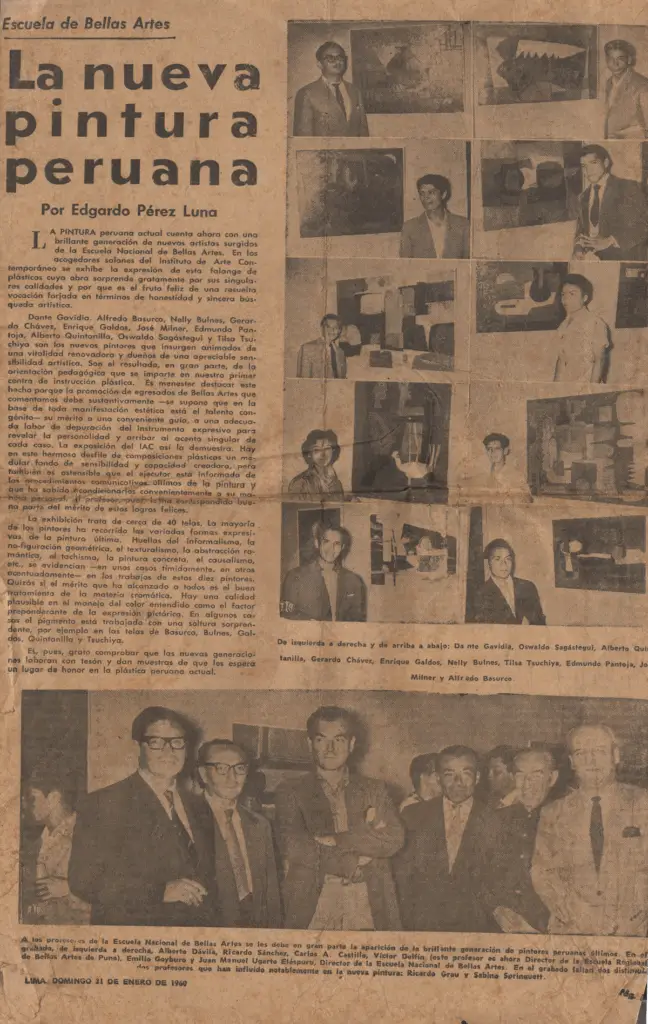
From left to right and from top to bottom:
Dante Gavidia, Oswaldo Sagástegui, Alberto Quintanilla, Gerardo Chávez, Enrique Galdos, Nelly Bulnes, Tilsa Tsuchiya, Edmundo Panta, José Milner and Alfredo Basurco.
The teachers of the National School of Fine Arts are largely responsible for the emergence of the most recent brilliant generation of Peruvian painters. In engraving, from left to right: Alberto Dávila, Ricardo Sánchez, Carlos A. Castilla, Víctor Delfín (then professor of anatomical drawing and Director of the Regional School of Fine Arts of Puno), Emilio Goyburu and Juan Manuel Ugarte Eléspuru, Director of the National School of Fine Arts. In engraving there are two distinguished masters who had a notable influence on the new painting: Ricardo Grau and Sabino Springett.
LIMA, SUNDAY, JANUARY 31, 1960