
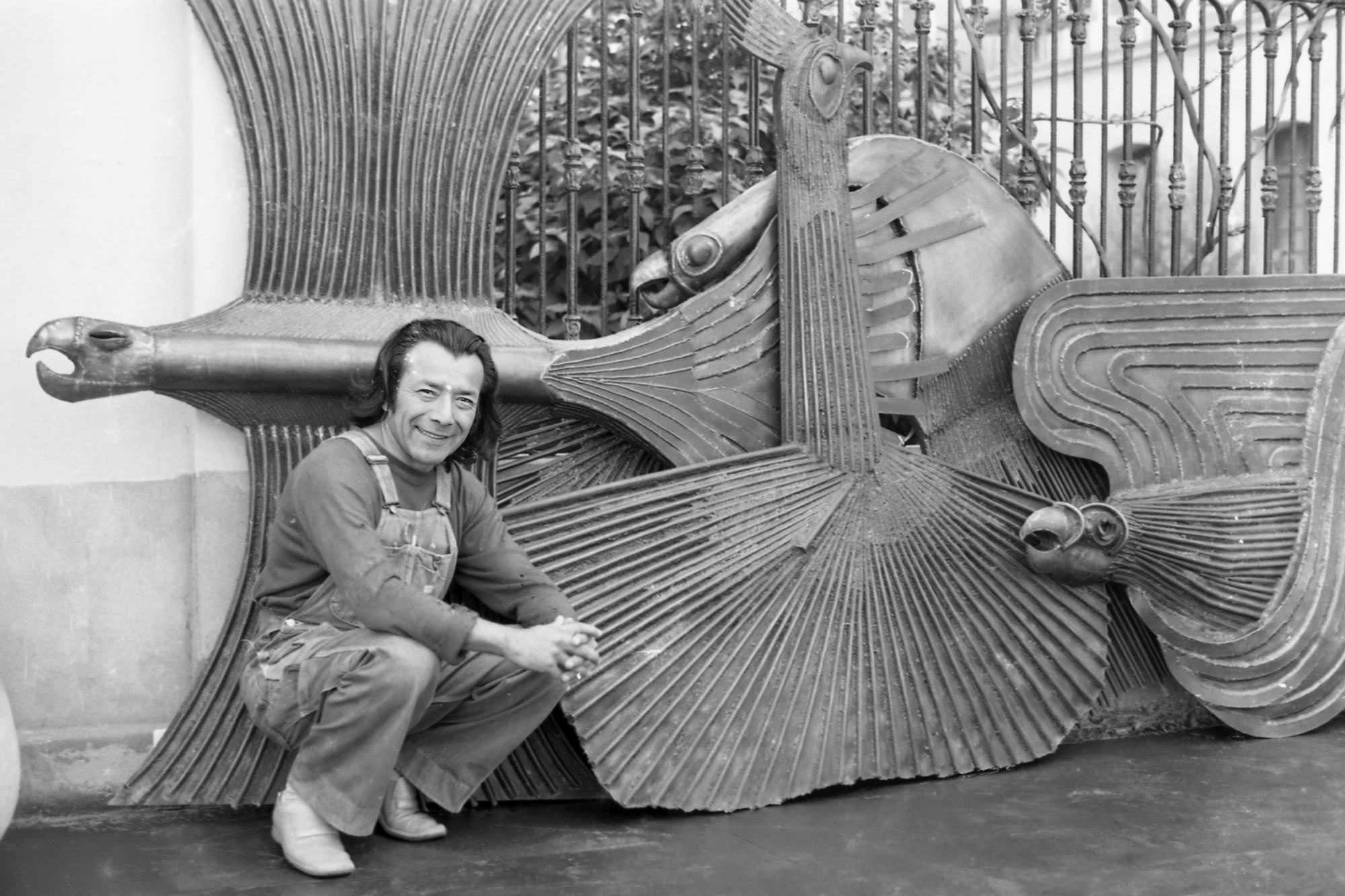
The artist with some of the sculptures from his series «Birds of America» (circa 1970). Archive Casa Taller Delfín.
Who is Victor Delfin?
Víctor Delfín Ramírez (Lobitos, Piura, 1927) is a Peruvian visual artist dedicated to sculpture, painting, printmaking, applied arts, and design. His career spans more than seven decades of continuous production and includes teaching, directing art schools, community-based cultural projects, public works, national and international exhibitions, and active participation in contemporary civic processes.
Early years and training
Victor Delfin was born in Lobitos, an oil enclave in the province of Paita. His father worked as a welder in a workshop dedicated to repairing large drills used in oil drilling, an environment that the young Delfín observed since he was a child.
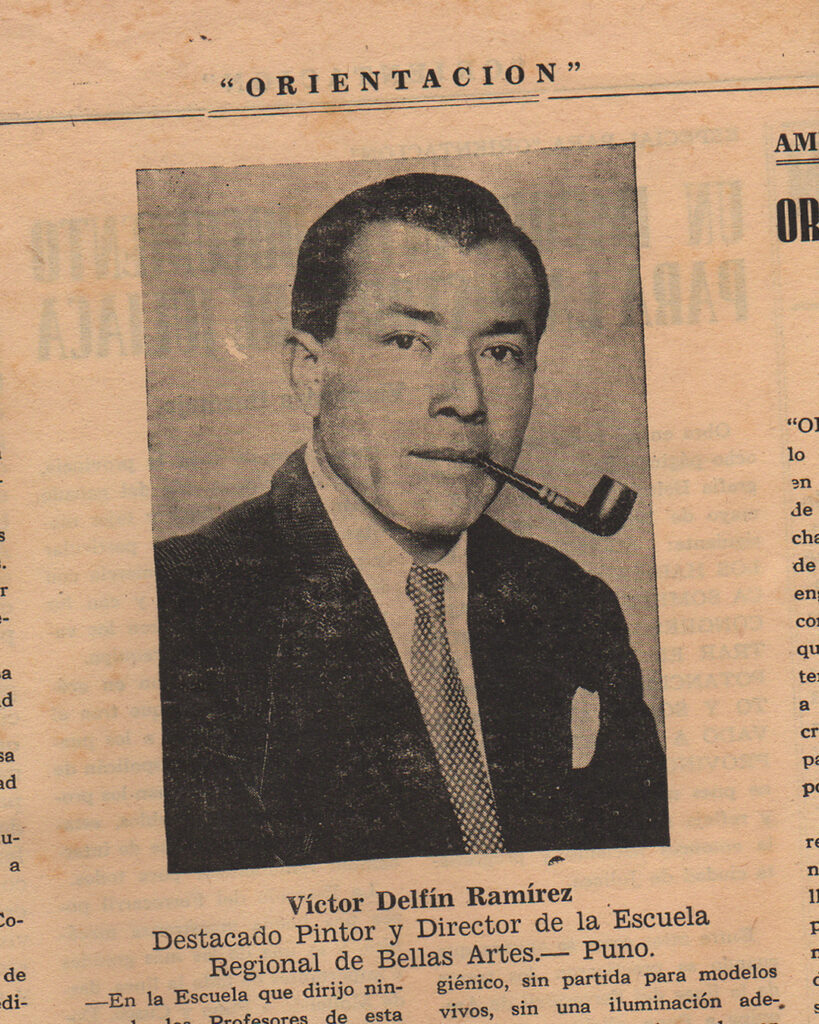
Joined the Peruvian National School of Fine Arts (ENBA) in 1945.
During his studies he alternated his classes with work as a construction worker to support his expenses, until he temporarily interrupted his education to move to Tingo Maria, where he lived with his family in a farmhouse near a place called Las Delicias, to dedicate himself to painting with greater freedom.
He later returned to Lima and concluded his studies in 1958, obtaining that same year the Ignacio Merino Municipal Painting Prize with the work Tribute to the civil construction worker .
In 1959 won the position of Director through a competitive process of the School of Fine Arts of Juliaca (Puno), from where he managed the restoration and implementation of classrooms in poor condition. Shortly after, he also assumed the direction of the ENBA headquarters in Ayacucho, which strengthened his contact with artisans and regional popular art.
Between 1962 and 1964 he lived in Santiago, Chile, where he organized an exhibition of Peruvian folk art at the Instituto Cultural de Providencia and worked as a teacher at the same institute and at the Instituto Cultural de Las Condes. During those years he made trips to Peru to visit craft fairs in regions such as Huancayo.
First series, techniques and materials
In October 1966 he held his first personal exhibition at the Art Center Gallery (Miraflores, Lima), consisting of altarpieces made of molten lead, ceramics and wood. That same year he also began to produce pieces in aluminum and acrylic, using materials derived from the manufacture of illuminated signs, such as aluminum tubes and angles.

Altarpiece by Víctor Delfín (with him seated with his back to the work) at the Hotel Crillón (c. 1970). Archive Casa Taller Delfín.
Since the end of the 1960s, he began to work with scrap metal from used machinery markets, such as La Parada and Tacora Motors. With these materials he created sculptures of animals -particularly birds- and series such as Bestiary y Zodiac Signs (both exhibited in 1968 at the IAC and the Museo de Arte de Lima, respectively). .
During the 1960s and 1970s he also produced utilitarian objects: furniture, lamps, gratings, stoves and buckles, integrating applied arts practices into his regular work. His workshop came to function as a small factory with workers and operators working full days of artistic production, especially during the 1960s and 1970s. .
Participation in Arte Nuevo (1967)
In 1967 he was part of the group New Art, together with Luis Arias Vera, Teresa Burga, Jaime Dávila, Gloria Gómez-Sánchez, Emilio Hernández Saavedra, José Tang, Armando Varela and Luis Zevallos Hetzel. The group produced a manifesto critical of the American Painting Festival and organized a parallel exhibition in an intervened locale in Jr. Carabaya, renamed as Adam's Navel, where Delfín installed a mural made with PVC pipes. The exhibition was later partially moved to the Museo de Arte de Lima. .
Birds of the Americas and international projection
In the early 1970's, Delfín developed the series Birds of America, composed of large-format metal sculptures. In 1970 he held two simultaneous exhibitions with these works: one in the gallery Art of Yesterday and Today in Caracas, and another in the Miami Museum of Modern Art, with fifteen and seventeen sculptures respectively.
Several aircrafts of the Braniff International company transported these multi-ton sculptures for subsequent exhibitions in cities such as Quito, Guayaquil, Bogota, Panama City, San Jose, Costa Rica, Santo Domingo, Barranquilla, Caracas and Havana. Some of the works remained in local collections, which motivated the artist to produce new pieces to continue the exhibition itinerary. .
Public works and production since the 1980s
In the 1980s he also worked on concrete sculptures, such as the Dove of Peace, installed in 1985 in front of the Apostolic Nunciature (Salaverry Avenue). At the same time, he took up painting again and exhibited his paintings in 1986 at the Editorial Concepts Gallery in Miami.
In 1992 he designed the sculpture known as The Kiss, installed in February 1993 in the Parque del Amor (Miraflores). The artist stated that the park was conceived as a public space intended to facilitate the affective expression of couples. The sculpture became a meeting point for celebrations, cultural activities and numerous rallies, especially during Valentine's Day. .
Casa Taller Delfín
In 1970, Delfín acquired a Tudor style house in Barranco, close to the demolition, which he rebuilt and restored as a house-workshop. The building served as a space for workshops, exhibitions, recitals, conferences, craft fairs and informal residences for artists. In December 1970, it was the site of a Contemporary Crafts Fair organized in collaboration with the Barranco Municipal Council, where participants worked indoors and exhibited in the district's public square. .
During the 1990s, the house was a meeting point for student collectives and human rights organizations linked to the opposition to the regime of Alberto Fujimori. Strategic meetings, coordination activities and protest meetings were held there. In July 2000, during the March of the 4 Yours, Delfín was injured by a direct hit from a tear gas canister fired in his face, which he publicly reported in the Peruvian press.
Civic activity and political work
In the 1990s, Delfín promoted public initiatives, such as a Peace Encounter between Peruvian and Ecuadorian artists and writers, held on the border weeks before the beginning of the Cenepa conflict (1995). That same year he joined the protests against the Amnesty Law of 1995, which benefited members of the Colina Group, and participated in subsequent marches against the dismissal of judges of the Constitutional Tribunal (1997). .
Between 1999 and 2000, he produced a graphic and pictorial series known as Political Bestiary, which circulated in posters and flyers during the mobilizations against the regime. In March 2000 he published an open letter addressed to Peruvian youth, with references to the political violence of previous decades. After the March of the 4 Suyos, Delfin publicly denounced the repression exercised by police forces during the days of protest against the presidential reelection.
Distinctions and Acknowledgments
Delfin received numerous national and international awards including:
- Ignacio Merino National Painting Award (1959).
- First Prize, National Biennial of Contemporary Crafts of Lima (1967).
- Order El Sol del Perú, degree of Commander (2001).
- Bernardo O'Higgins Order (Chile).
- National Order of Merit (Ecuador), Officer grade.
- Meritorious Personality of Culture, Ministry of Culture of Peru (2018).