
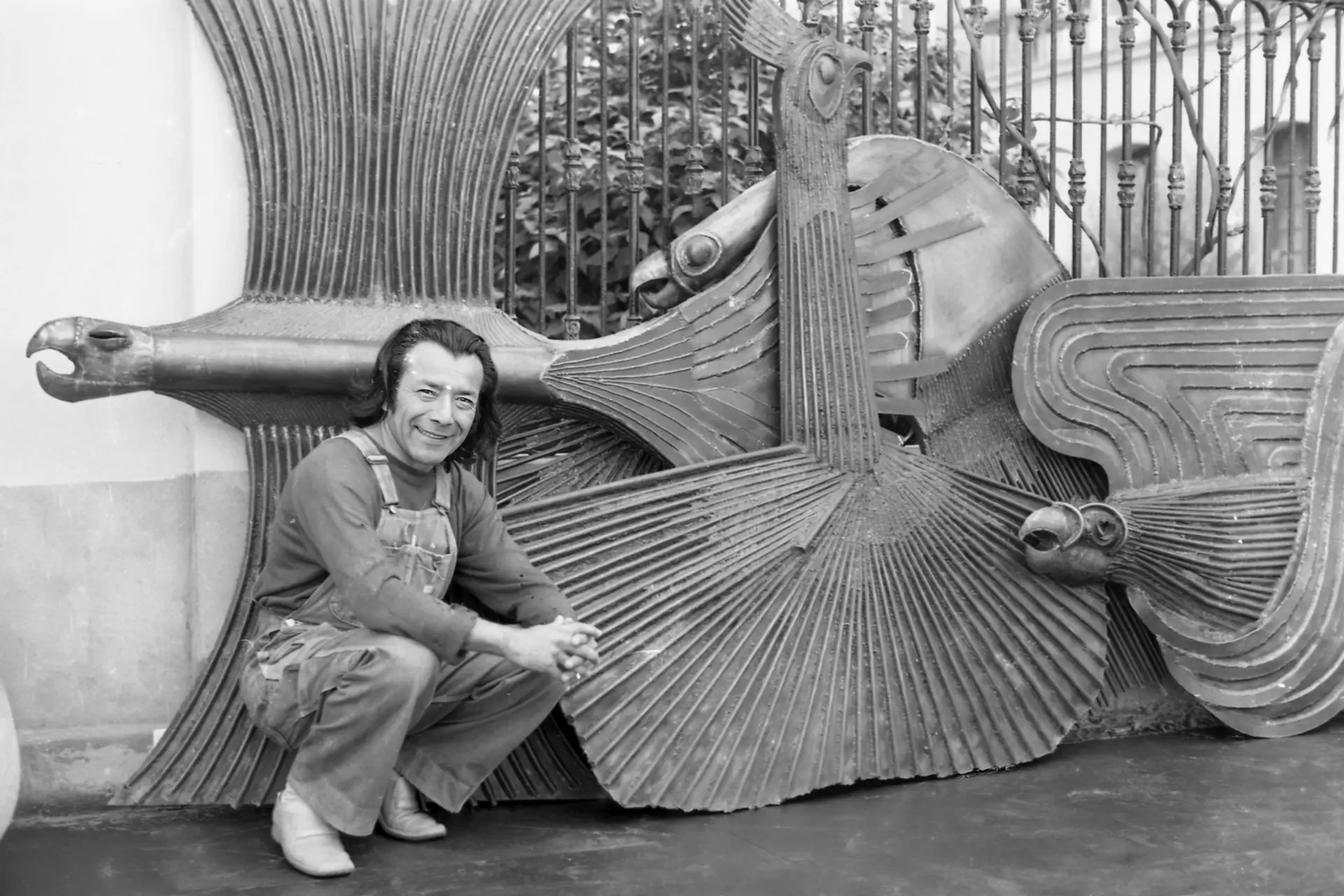
The artist with some of the sculptures that are part of his «Birds of America» series, circa 1970. Delfín Workshop House Archive.
Victor Delfin
Víctor Delfín Ramírez (Lobitos, Piura, 1927) is a Peruvian artist whose career spans over seven decades of production in sculpture, painting, printmaking, applied arts, and design. His practice has been characterized by experimentation with materials and techniques, dialogue with Peruvian folk art, and a constant relationship between artistic creation and public life.
In addition to his artistic production, Delfín has engaged in teaching and art school administration, promoted cultural projects and meeting spaces, and actively participated in civic movements linked to the defense of democracy and human rights in Peru.
Biography
Early years and training
Víctor Delfín was born in Lobitos, an oil enclave in the province of Paita. His father worked as a welding laborer in a workshop dedicated to repairing large drills used in oil drilling, an industrial environment that Delfín observed from childhood and which precedes his later interest in working with metals and industrial materials.
He entered the National School of Fine Arts of Peru (ENBA) in 1945. During his studies, he alternated classes with work as a construction laborer to support his expenses, until temporarily interrupting his training to move to Tingo María, where he lived with his family and dedicated himself to painting.
Later he returned to Lima and completed his studies in Fine Arts. At the end of that stage, he won the Ignacio Merino Municipal Painting Prize with the work Tribute to the civil construction worker.
In 1959, he won through a competition the directorship of the School of Fine Arts of Juliaca, in Puno, where he worked on the recovery and implementation of its teaching spaces. Shortly after, he also assumed the directorship of the ENBA branch in Ayacucho. These experiences strengthened his contact with artisans, traditional techniques, and various expressions of Peruvian popular art.
Between 1962 and 1964 he lived in Santiago, Chile, where he organized an exhibition of Peruvian folk art at the Cultural Institute of Providencia and worked as a professor at that institution and at the Cultural Institute of Las Condes. During those years he continued traveling to Peru and visiting fairs and artisanal production centers.
In 1966, he held his first solo exhibition at the Galería Art Center in Miraflores. From then on, he developed an extensive career of exhibitions, public projects, and artistic production inside and outside of Peru.
Play
Victor Delfin's production is characterized by a constant search for materials, techniques, and forms of production. Throughout his career, he has worked with painting, wood, ceramics, lead, aluminum, iron, acrylic, cement, and industrial and recovered materials.
Materials and initial series
In his first solo exhibition, held in October 1966 at the Art Center Gallery, he presented altarpieces made of cast lead, ceramic, and wood. During those years he also began producing pieces in aluminum and acrylic, using materials from the manufacture of illuminated signs.
Since the late 1960s, he worked with metal scrap from used machinery markets in Lima, such as La Parada and Tacora Motors. With these materials, he developed sculptures of animals, particularly birds, and series such as Bestiary y Zodiac Signs, exhibited in 1968 at the Institute of Contemporary Art and the Lima Art Museum, respectively.
During the 1960s and 1970s, he also produced furniture, lamps, grilles, stoves, buckles, and other objects, integrating the applied arts into his practice. His workshop eventually operated with workers and assistants directly involved in the production processes.
New Art
In 1967 Delfín became part of the Arte Nuevo group along with Luis Arias Vera, Teresa Burga, Jaime Dávila, Gloria Gómez-Sánchez, Emilio Hernández Saavedra, José Tang, Armando Varela, and Luis Zevallos Hetzel.
The group produced a manifesto critical of the American Painting Festival and organized a parallel exhibition in a venue on Carabaya Street, renamed as Adam's Navel. There Delfín installed a mural made with PVC pipes. Part of the exhibition was later moved to the Lima Art Museum.
Birds of America
In the early 1970s, Delfín developed Birds of America, a series of large-format metal sculptures.
In 1970, he simultaneously presented these works at the Arte de Ayer y Hoy gallery in Caracas and the Museum of Modern Art in Miami. Afterwards, the sculptures circulated through various Latin American cities, among them Quito, Guayaquil, Bogotá, Panama City, San José, Santo Domingo, Barranquilla, Caracas, and Havana.
The international circulation of these pieces consolidated a stage in Delfín's work characterized by experimentation with metal, monumentality, and an animal iconography that would reappear in different ways throughout his career.
Public works
Delfín's production also includes numerous projects conceived for public spaces.
In 1985 he made the Dove of Peace, a concrete sculpture installed in front of the Apostolic Nunciature on Salaverry Avenue in Lima.
In 1992 he designed The Kiss, installed in February 1993 as the centerpiece of the Miraflores Love Park. Conceived as a public space dedicated to affectionate expression, the park and the sculpture later became one of Lima's most recognizable urban spaces.
Art and Public Life
The trajectory of Víctor Delfín has been closely related to Peruvian public life. His civic participation has included the defense of democracy and human rights, cultural initiatives, and public actions in moments of political and social conflict.
During the 1990s, the Casa Taller de Barranco became a meeting space for students, artists, activists, and human rights organizations linked to the opposition to Alberto Fujimori's government.
In 1995, Delfín promoted a Peace Gathering between Peruvian and Ecuadorian artists and writers in the context of the border tensions that led to the Cenepa conflict. That same year he participated in mobilizations against the Amnesty Law and, subsequently, in protests against the dismissal of magistrates of the Constitutional Tribunal.
Between 1999 and 2000 he produced a series of images known as Political Bestiary. Some of these works circulated as posters and graphic materials during the mobilizations against the Fujimori regime, directly linking their artistic production with their civic activity.
In March 2000, he published an open letter addressed to Peruvian youth. Months later, he participated in the March of the Four Suyos, during which he was injured by a tear gas canister. He subsequently publicly denounced the repression carried out during the days of protest.
This civic dimension constitutes an important part of Delfín's trajectory and of the documentary history preserved by the Association.
Casa Taller Delfín
In 1970, Delfín acquired a Tudor-style house in Barranco that was facing demolition and began a process of recovering and transforming the property into a home and studio.
Since then, the House-Studio has functioned not only as her main creative space, but also as a venue for cultural encounters. Over the years, it has hosted workshops, exhibitions, poetry readings, lectures, craft fairs, meetings, and informal artist residencies.
In December 1970, for example, a Contemporary Handicraft Fair was held there, organized in collaboration with the District Council of Barranco. The participants worked inside the House and later exhibited their work in the public space of the district.
The Casa Taller brings together today works, documents, photographs, publications, objects, and other materials linked to more than five decades of work in this space. Its preservation constitutes one of the main responsibilities of the Casa Taller Delfín Civil Association.
Selected trajectory
1927 — Born in Lobitos, Piura.
1945 — Enter the National School of Fine Arts of Peru.
1959 — Take over the direction of the Juliaca School of Fine Arts.
1962–1964 — He lives and works in Santiago de Chile.
1966 — First solo exhibition at the Art Center Gallery, Lima.
1967 — Integrates the Arte Nuevo group.
1968 — Present Bestiary y Zodiac Signs.
1970 — Elaborate Birds of America and establishes his Workshop House in Barranco.
1985 — Perform Dove of Peace.
1993 — The Love Park and are inaugurated The Kiss in Miraflores.
1995–2000 — Actively participates in initiatives and mobilizations for peace, democracy, and human rights.
2001 — Receives the Order of the Sun of Peru in the rank of Commander.
2018 — He is recognized as a Meritorious Personality of Culture by the Ministry of Culture of Peru.
Distinctions and awards
Among the distinctions received by Víctor Delfín are:
- Ignacio Merino Municipal Painting Award.
- First Prize, Lima National Biennial of Contemporary Handicrafts (1967).
- Order of the Sun of Peru, Commander rank (2001).
- Order of Bernardo O'Higgins, Chile.
- National Order of Merit, Officer rank, Ecuador.
- Meritorious Personality of Culture, Ministry of Culture of Peru (2018).
Explore
Catalogue Raisonné
Learn about the research and documentation project on the work of Víctor Delfín.
File
Explore the preservation work of the documentary, photographic, press, and audiovisual archive.
WORKSHOP HOUSE
Discover the creative and meeting space that Delfín established in Barranco in 1970.